What, exactly, is the problem?
Immigration rates are around where they have been for 80 years. There is little evidence that they have suddenly become too high. But there is evidence that movements on the far right have reawakened and legitimized racist attitudes.
The numbers – 80 years of one percent immigration
We should be sceptical when an “everyone knows” consensus develops. “Everyone knows” Australia is a high-tax country, “everyone knows” that renewable energy is responsible for high energy prices, and now “everyone knows” that our level of immigration is too high.
Last week’s roundup concluded with this graph, showing that the rate of immigration has fallen back to its pre-pandemic level, of around 1.0 percent a year.
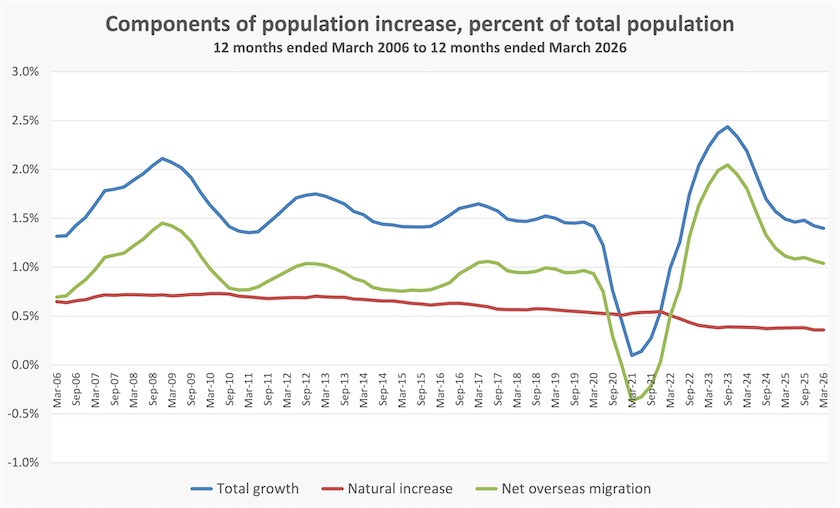
Subsequently a reader has reminded us that during what are known as the “postwar years” from 1945 to around 1970, the government had an announced immigration target of 1.0 percent, even though in those years our rate of natural increase was much higher than it is now.
Our confusion about immigration was on full display in the ABC’s National Forum on Immigration, an 80-minute babble of infotainment. The experts were there – Abul Rizvi, George Megalogenis and Casey Briggs – but their contributions were drowned out by those who had no interest in a rational, informed discussion. Barnaby Joyce’s was the loudest, most disruptive and least informative voice, as he repeated Pauline Hanson’s thought bubbles, made strange references to “metaphysics”, and in dominating the discussion denied the audience the opportunity to hear more from the grown-ups in the studio. John Anderson saw the forum as an opportunity to blame immigration for every problem our nation is experiencing, and to assert once again that Australians have made a terrible mistake in not electing a Coalition government. Minister Amanda Rishworth was anything but clear: she isn’t the immigration minister and the government was just three days off announcing its policy. At the end Tom Calma came on in a cameo appearance, but as a spokesperson for those most affected by immigration his perspective should have set the framework for the forum: the rest of us, 96 percent of Australians, are or are descended from immigrants.
The hard truth – racism re-awakened
Hanging over the ABC forum was something not to be mentioned – racism. But Nyadol Hyuon, in the most diplomatic way, brought it up, as did students who were invited to give short accounts of their experiences. And there was the occasional mention of Pauline Hanson.
Hanson has gone well beyond dog whistling: she is clear about her attitude towards some people who have made their home here, particularly Muslims, and she has made offensive remarks about people who have been here for a very long time. Her electoral success has been strongest in places with dominant “white”, particularly British, ancestry.
The chart below, constructed from Department of Home Affairs data, illustrates what seems to be grabbing One Nation’s attention.
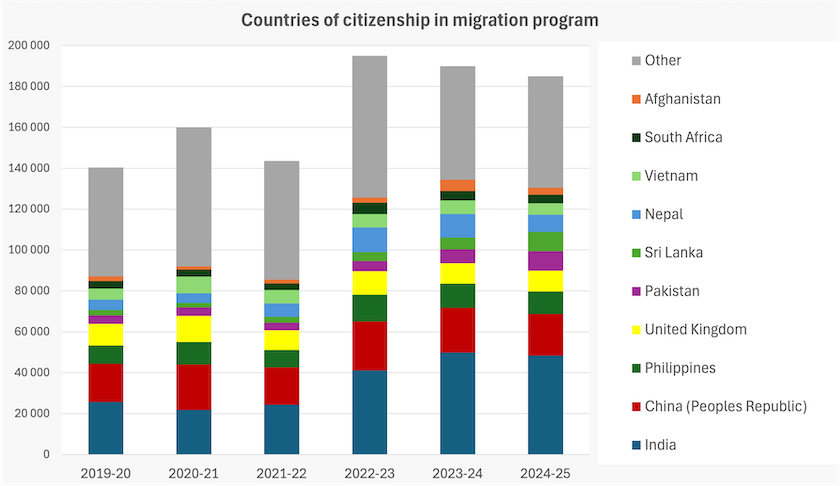
Note the yellow series – the UK, now just 6 percent of our intake. In the postwar wave of immigration 30 to 45 percent of our migrants came from the UK, and migration from other European sources brought that proportion up to 85 to 90 percent. Writing in Pearls and Irritations about One Nation’s influence on the immigration debate, Jack Waterford states:
Pauline Hanson has long been campaigning against migration, particularly migration of the wrong type, by which she has clearly meant people of Asian or African extraction, and people of Muslim faith. It’s quite clear that feelings about the ‘browning’ of the population are at the core of her anxieties.
There are others, some of whom have tried to infiltrate her movement, who are frankly racist, and who believe that there is some sort of conspiracy afoot by which white Christian civilisation is being discriminated against and supplanted by sinister world government conspiracies. A good deal of this is borrowed from bigoted American sources, which have these days become respectable given the enabling of the opinion by people such as Donald Trump, Pete Hegseth and the media employees of Rupert Murdoch. But it has long had a respectable lineage in white Australian circles, in old sectarian warfare, and, early, in resistance to migration from the Mediterranean (sometimes a code word for bigotry against Catholics, Jews and Muslims). The politicisation of the boat people and refugee ‘invasions’ gave a colour of national security and terrorism threat, which ‘permissioned’ a frankly prejudiced and hostile part of the community, particularly in regional areas where multiculturalism had less sway.
Hanson’s appeal to a monoculture and a nostalgia for a (White Australia policy) time when most Australians were white and of British or northern European background is deliberate and sharpened by focus groups, however sincerely her personal grievances are held.
We cannot sweep racism under the carpet, or pretend that people’s only concern with immigration is about the numbers.
The Australian Human Rights Commission, in its report Racism and affected communities, is clear in its finding that in spite of Australians’ strong support for multiculturalism, “racism is nonetheless pervasive in Australia and causes real harm to people every day”, and, more disturbingly, that “racial discrimination and racial vilification have increased in Australia”.
That report emphasises racism as experienced by First Nations, Muslim, and Jewish Australians, and people from certain countries in the Middle East. It draws on reports of personal experiences, such as those maintained by the Islamophobia Register.
Particular communities report on instances of racism. For example the Social Equity Institute at the University of Melbourne has reported on Racism experiences by African students in Australian educational institutions.
With good recording we can get some feeling for trends in specific instances of racism, ranging from personal insults through to physical attacks on communities and their institutions. This is important, not only because of the harm inflicted on individuals, but also because news of racist instances spreads quickly within Australia and abroad, raising fear among immigrant communities, and dissuading people from wishing to come to Australia as migrants, students, businesspeople or holidaymakers.
But according to a group of academics associated with Melbourne’s Centre for Resilient and Inclusive Societies there is much we don’t know about racism in Australia. Their journal article Racism data in Australia: a review of quantitative studies and directions for future research is largely about what we don’t know. Is it about skin colour, as hinted by that weird idea that the world can be divided into “white” and “people of color”? Is it about habits some people find confronting, such as clothing? Is it about “replacement” – a fear that all these hard-working Asians will leave the old native population behind? (From a different perspective, another term for “replacement” is “improving the gene pool”.)
There is another dimension to racism, as described in the Human Rights Commission’s report The struggle to be seen, the power of being heard. To quote:
Although we heard about instances of interpersonal discrimination and harms, many of the stories shared with us highlighted the ways racism is embedded in social norms, institutional policies and practices, and broader systems.
That is difficult territory, because the idea of institutional racism can lead one down a path of irrationality. Some who call themselves on the “left” claim that white people can never understand institutional racism (and similarly that men can never understand institutional sexism). But institutional racism exists, because “people of colour” feel it, even if they cannot describe it in white people’s terms because the processes of academic research are institutionally contaminated.
Such postmodern thinking, that denies the possibility of a test for falsification, belongs in the same place as the denial of climate change and Pauline Hanson’s statements about Aboriginal people lacking the capacity to invent a wheel. But we should not dismiss the idea of institutional racism just because some on the woke left have distorted the idea.
We don’t have to go down the rabbit hole of postmodernism to find evidence of racism in our patterns of behaviour. It wasn’t until 1962 that Aboriginal Australians were guaranteed the right to vote. Gough Whitlam and Malcolm Fraser may have abolished the White Australia policy, but the ideas that supported it didn’t die a sudden death. It’s not long ago that Aboriginal people were barred from using council swimming pools in some country towns. More widespread were facilities, including rail carriages, bars, the first few rows in country cinemas, which were understood to be for aboriginal people only.
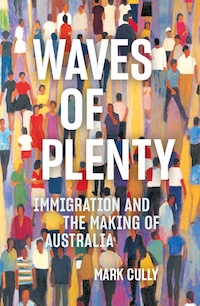
On Late Night Live Mark Cully, discussing his book Waves of plenty: immigration and the making of Australia, takes us through a history of immigration in Australia. Those who have come to Australia have a tendency to pull up the drawbridge, fashioning a migration policy by defining who they want kept out: The “miracle” of Australia’s migration story.
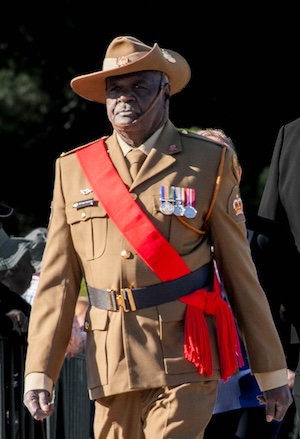
Marcia Langton has an article in the Saturday Paper – Who wants to be a traitor? – describing the way ideas of “patriotism” have been fashioned. Some of that fashioning is around the stereotype of the “white” Anzac hero who can do no wrong. (She defends those soldiers, including Andrew Hastie, whose moral judgement is not blinded by that stereotype.). She reminds us of the terrible disrespect shown to Aboriginal soldiers on their return to civilian lives after serving in the 1914-18 War and the Pacific War, and the way Aboriginal war veterans were booed at Anzac Day ceremonies last year. She calls out those responsible:
The booing was not spontaneous. It was amplified by far-right networks online and encouraged by One Nation figures who had railed against the “politicisation” of Anzac Day.
In the wider community there is still the influence of a blatantly racist education system. The parents and grandparents of older Australians were brought up on school books that described “the European peoples as the finest types of mankind” and lied about their achievements.[1]
It takes decades for a society to purge that toxic filth from their consciousness, and it’s too easy for politicians, unbound by any moral framework that respects all people, to re-awake those sentiments.
1. Three of the introductory paragraphs from The World and its People, Thomas Nelson, London, 1910, a standard text on the Victorian school syllabus in the 1910s:
The European peoples are the finest types of mankind. They have led, and they still lead, the way in peace and in war. They have advanced farthest in wisdom, skill, and knowledge. They have journeyed afar to dwell in most of the best lands of the globe, and now the European peoples at home and abroad, govern the whole earth.
They have found out many of the secrets of nature, and have made the forces of nature, their servants. They have invented gunpowder, the mariner's compass, the art of printing, the railroad, the steam engine, the telegraph. They have explored the oceans and distant lands, they have reared lordly cities, raised noble buildings, written great books, painted wonderful pictures, composed sweet music, and studied the art of healing.
For them, the negro toils in the cane-brake, the Eskimo chases the seal, the Indian traps fur-bearing animals, the African crushes out his palm-oil, the Chinaman grows his tea, the Kanaka dives for pearls, and the Kafir watches his sheep. To provide the European with all that he wants, most of the other nations are engaged in labour. The raw products which they provide he skilfully works up into manufactured goods for the use of all men.↩
The government’s policy
The government has wisely not over-reacted to calls to cut migration, but it does recognize that there are too many people in Australia on short-term visas.
Tony Burke outlined the government’s immigration policy in a (delayed) Press Club Address. There is a transcript on his website, and if you want to follow the Q&A there is a video on the ABC website.
His presentation comes across as one that a public servant might make. It’s descriptive and straightforward, with few partisan barbs. He’s well-briefed on details, and handles difficult questions from the press with ease. It’s more about fixing a system that has accumulated a few problems, rather than undertaking a fundamental re-design.
That cautious incrementalism, and reliance on changes that haven’t been carefully researched, has brought forth criticism from those who believe more comprehensive changes are necessary. For example Peter McDonald of the University of Melbourne has a Conversation contribution – The government’s migration policy prioritises knee‑jerk politics over careful planning – detailing those concerns.
Nevertheless, three themes emerge from the presentation, only the first of which is explicit.
That explicit principle is that the government should not allow the demands of employers and universities to drive our migration program. Rather it must take more control of the process: it is up to the government to determine “who arrives; who stays; and who leaves”, with emphasis on staying and leaving rather than arriving.
The theme of taking back control is reminiscent of Howard’s “we will decide who comes to this country and the circumstances in which they come”, expressed in a more genteel way.
Less explicit, but evident through his speech, is Burke’s concern that there are too many people in Australia renewing short-term visas. Age/Sydney Morning Herald journalist Eryk Bagshaw has an article “I’m very worried about it”’: Burke’s warning on Australia becoming a guest worker economy, describing Burke’s concern, and the department’s concern, about the number of people on temporary visas. He quotes Burke:
Having a large number of people who are here temporarily is not necessarily a problem if they are here temporarily … but if you have people who are in fact living here permanently and realistically will never live anywhere else...that’s not a smart way to operate.
In support of that concern, Bagshaw describes the strong growth in temporary visas, in comparison with permanent places delivered.
Burke admits that Australia has become highly dependent on temporary visa holders in various categories, and that any strong action to curtail their use would have bad effects on agricultural, construction and care industries, and on universities. But he is concerned about Australia developing some of the same problems as Germany experienced with its Gastarbeiter (guest worker) system, which resulted in many people leading dual lives in Germany and Turkey, without having a firm attachment or commitment to either country.
It’s only a 22-hour drive from Frankfurt to Istanbul. Our temporary workers have further to travel to their countries, but cheap air fares, while being of tremendous benefit for labour flexibility, have allowed some of the Gastarbeiter patterns to develop.
In this context it’s telling to consider what John Howard now has to say about migration in an interview recorded by Bagshaw – “One of the great Australian achievements”: Howard praises immigration.
We wanted migrants who would embrace this country. We didn’t require of them that they forget the country of their birth. Nobody wants you to do that,” he said.
If your parents were born in Italy, or if they were born in Lebanon, if they were born in China, why should you ask of them that they give up affection for the country of their ancestry? We did require of them that they become fully part of the Australian community.
There are echoes of Henry Lawson’s nationalism in that statement. There are also echoes of debates in the lead-up to Federation, in which White Australia was a defining issue. Overwhelmingly White Australia had its base in racism, particularly an arrogant belief in the superiority of people of British stock. But there was also a more enlightened argument in favour of White Australia, put forward by those who did not want Australia to go down the path of a dual workforce, with a “white” upper class and a “coloured” lower class – a plantation economy model. This movement overlapped with the general left-wing concern about an oversupply of migrants from poor countries suppressing wages for all workers.
Unfortunately Pauline Hanson and other right-wing populists have framed migration as something we are either “for” or “against”, ruling out the possibility that we welcome those who come to make their home here, while we may not like having too many foreigners coming and going.
The third theme, not at all explicit but evident from some of the measures announced, is that most of the costs of any change should be borne by actual or aspiring migrants. These include increased visa fees that took effect from July 1, particularly for partner visas ($11 710). New restrictions apply to spouses of undergraduate students.
Australians, like Americans, assume that there will always be “huddled masses yearning to breathe free” in our countries, a view repeatedly confirmed by 80 years of experience since 1945, and which is a basic assumption of the just released Intergenerational Report. But how long can that model last? When will we be in competition with Japan for migrants, or with an ageing and increasingly prosperous China? Such reversals in national attitudes are unimaginable right now but demographic pressure can force great changes – as happened in our own country after 1945. We should not lose our reputation as an attractive place for migrants.
The others to bear the cost are universities, particularly those dependent on large numbers of foreign undergraduates. (The old established universities may be comparatively less affected.) In a Conversation contribution – Life just got tougher for international students under new visa rules: why is this group being targeted – Peter Hurley and Melinda Hildebrandt of Victoria University present compelling evidence that the Albanese government has been trying to lower the number of international students in Australia. They explain the consequences of this for universities, which have become so dependent on foreign students, and for the broader community which is heavily dependent on student labour.
Because foreign students have become such an important source of funding for universities, subsidizing domestic students and universities’ research spending, any cutback on foreign students means fewer Australians will be graduating from university, explains Alan Kohler in a short clip: why universities are bearing the brunt of the immigration debate. But this clashes with the government’s higher education objectives, and there is no sign that the government has any intention of increasing funding to universities.
One issue raised in the ABC forum on migration was the long lead time in obtaining approval for family member visas. Burke promised no relief, but he suggested that if people wanted family members to join them they could do so straight away, bringing them in as tourists, leaving before their visas expire and reapplying. It comes across as a form of indirect subsidy for airlines (perhaps Catherine King, Minister for promoting the welfare of airlines, had something to do with it) but Burke’s concern seems to be with the numbers, because tourists, who come in on short-term visas, do not count in net overseas migration numbers. NOM numbers bad, tourist numbers good.
This illustrates how immigration numbers, rather than more basic issues to do with our population policy, the purpose of immigration, our criteria for selecting migrants, and the commitment migrants make to Australia, have come to dominate public discussion. This point is stressed in Jack Waterford’s contribution to Pearls and Irritations, criticizing the government for having allowed One Nation to set the agenda: One Nation will not be defeated by tiny tweaks. He writes:
There is no formula capable of describing the ideal number of migrants, or the type of them which should be allowed. There never has been. One can give some appearance of objectivity by referring to the state of the labour market, or the birth rate, or demands for labour in various industries or regions, but even then it is primarily a matter of opinion.
The government also seems to be influenced by the Coalition’s talk about matching immigration to completion of new houses. They know the relationship is weak, but Burke rationalizes the government’s concession to that point with the argument that because there are now fewer persons per household, house construction has fallen further behind demand. Therefore, Burke says, “we need immigration to soften enough that housing has a chance to catch up”.
A clever but unconvincing rationalization.
The pre-migration story
A pre-1788 estimate of Australia’s population and its subsequent decline reveals the invasion’s terrible disruption to the indigenous population, and the resilience of their culture.
For a long time, historians and others have worked with a guesstimate that in 1788, just before the British invasion, there were about 300 000 indigenous people in Australia.
Using three independent ways of updating that estimate – radiocarbon dating, genetic data, and the productivity of natural resources – a team of researchers have come up with a conservative estimate of 2.2 million as the pre-invasion population of Australia.
A summary of their methodology and findings, with a link to their publication in Nature Human Behaviour, is in a post by the University of New South Wales: More than 2 million Indigenous people lived in Australia in 1788.
They estimate that over 90 percent of the indigenous population died in the 70 years after 1788. This fall is explained by massacres, by removal from country, and other deliberate violence, but the big killer was smallpox, in three waves – one that would have come with the first fleet (and didn’t spread far), one in the 1830s and one in the 1860s.
That’s the grim aspect of their research. The more uplifting aspect is about how the surviving, and now expanding indigenous population, managed to preserve and share their culture.
You can hear Corey Bradshaw of Flinders University explain the project on Radio National: Australia's Indigenous population before European colonisation almost nine times higher than estimated. (6 minutes)