Other politics
The Coalition on education
The Coalition’s ideas on school education resurrect a model of compartmentalised subjects and boot-camp classroom discipline.
Julian Leeser, Coalition spokesperson on education, has used his address at the Education for Human Flourishing Conference as the opportunity to announce “the Coalition’s policy to restore excellence in Australian schools”.
The most significant aspect of that policy is about the school curriculum. He also has suggestions for arresting the widening gap between girls’ and boys’ learning, incorporating “western values and culture” into children’s learning, improving discipline in schools, shortening teacher training, and controlling students’ screentime.
His criticism of the curriculum is based on a comparison between Australian students’ generally stable performance in NAPLAN tests, contrasting with their worsening performance in PISA. NAPLAN is based on students’ mastery of the Australian curriculum, while the international PISA assessment “focuses on their ability to apply what they have learned in school to real-world problems and situations” (ACER PISA in Brief Australia 2025).
One may interpret that difference as an indication that our curriculum is too rigid and inflexible. Our students should not be restrained by artificial boundaries in disciplines: for example our math curriculum should help students understand how mathematics is used in ecology, biology, and even in history.
But in a not fully developed chain of logic, Leeser comes to the diametrically opposite conclusion, suggesting that the curriculum must be tightened up by “removing the cross-curricular priorities”. He specifically identifies three such priorities: “Aboriginal and Torres Strait Islander Histories and Culture, Asia and Australia’s engagement with Asia, and sustainability”.
What starts off as a well-researched analysis of NAPLAN and PISA scores suddenly switches to the Coalition’s hard line of removing anything that wasn’t in the 1950 curriculum – all that stuff about Aboriginal people as if they have anything to teach us, the silly idea that we are closer to Asia than we are to Britain, and woke content about “sustainability” whatever that means in a land of unlimited resources.
This is followed by an emphasis on “western values”, one of those terms thrown around as a floating signifier – a deliberately vague term into which anyone can provide their own meaning. For some it may mean incorporation of the ideas of the Enlightenment, while for others it could mean that somehow, through selective breeding or epigenetics, western Europeans have developed into a master race.
It’s dangerous rhetoric, and it contrasts with a more liberal and less compartmentalised view of education expressed by John Hewson in the Saturday Paper Are we forgetting the value of education? where he concludes:
My main concern here is that we are losing the real sense and value of education, and the pursuit of knowledge for knowledge’s sake. This is so important in the very challenging world in which we now live and are attempting to survive. The value of reading, research and critical thinking, with the experience of civics, finance, history and philosophy, should not be underestimated. Our schools and universities should be finely tuned to provide this opportunity to all Australians. It is, quite simply, a necessity.
Leeser calls for students to learn specifically about “our British foundation”, and pride in our flag – even though what is called the “Australian” flag was constrained by our colonial masters to include their own flag in the canton position. Leeser talks about “pride in Australia, its history and its place in the world” but without taking a breath he moves into the colonial mentality of a special relationship with a country on the other side of the planet and loyalty to its monarch. This is the mentality that cost 60 000 Australian lives in Europe’s 1914-18 war, and up to the present day has seen our policymakers subjugating our interests to those of the UK, the most recent example being Morrison’s AUKUS deal based largely on helping the UK rescue its shipbuilding industry from French competition, at great cost to Australia.
There may be a case for tweaking the curriculum, but it should be an Australian curriculum, not something resurrected from colonial times.
His ideas on boys’ learning, teacher training and workloads, and classroom discipline, tap into problems recognized by education experts. See, for example the Conversation explanation of PISA results by Therese Hopfenbeck of the University of Melbourne: Australia’s reading and maths results are at an “all‑time low” – but there’s more to the story.She, other educationalists, and most teachers, recognize that classroom discipline is a problem, but they realize there is no simple solution.
In this context Leeser’s idea that former soldiers should be re-trained as teachers so that they can apply the military’s discipline in the classroom is ridiculous. For lower ranks military culture is based on command and control. But for higher ranks, where senior officers must exercise flexibility and judgement, there is a return to liberal learning in staff colleges. Perhaps Leeser’s idea might have relevance if it were restricted to those officers who had achieved the rank of colonel or above. Or perhaps he really is attached to long-discredited ideas of rigid classroom control, in which case his ideal may be the mullahs in madrassas who teach boys to learn the Koran by heart.
The really big issue Leeser ducks is school funding. He refers to the fact that over the 7 years to 2022 “total funding paid by the Commonwealth to support Australian schools rose every single year and increased by 86 percent over the period, with the government school component of that funding more than doubling”. Unless these figures are adjusted for the adequacy or otherwise of the 2015 base, for inflation, for the intrinsic labour-intensity of education, and changes in school population, they are meaningless. Education analysts agree that combined Commonwealth and state funding for government schools rose over this period, but funding for non-government schools rose even more strongly, contributing to the drift of students, particularly high school students, to private schools, and opening up class divisions.
Leeser defends support for private schools, on the basis of “supporting parents to choose the schools that are right for them”. But how is this in line with his principle of “supporting national identity and social cohesion”, when children are separated into religious-based schools (Catholic, Islamic and Jewish), single-sex schools, and schools affordable only by multi-millionaires? Does he not acknowledge that many of the problems he correctly identifies, particularly those to do with discipline, are a result of the residualisation of public education?
If the Coalition wants to develop a school policy a starting point could be the nineteenth century ideal that school education should be “free, compulsory and secular”.
The Liberals’ pitch to One Nation voters: cut fuel excise
The Liberals’ idea of cutting fuel excise and cutting tobacco excise is really bad economics, but it’s a nifty political pitch to winning back voters from One Nation.
The Coalition has put forward its policy Fuel Price Shield (why do they use silly, pretentious names?), which would see fuel excise, presently 53.7 cents a litre, halved whenever the two-week average closing price of Brent crude is above US$100 a barrel.
There is something strange about the Liberal Party proposing to cut what we pay when we use roads, while at the same time they are criticizing the Victorian government for its neglect of road funding. Policy consistency never was one of the party’s strong points.
The stated idea is that the cut would provide cost-of-living relief, and would help bring down the CPI and therefore reduce pressure on the Reserve Bank to raise interest rates. Always obsessed with fiscal bookkeeping, rather than with economics, they propose the fuel excise cut would be funded by a cut in tobacco excise. That is based on a claim that lower cigarette excise would undermine the cigarette black market and restore the government’s capacity to collect revenue from tobacco excise.
Both measures are clearly aimed at winning back support from those who have drifted from the Coalition to One Nation. Those monstrous fuel-guzzling Ford Raptors and Dodge Rams are mobile displays of their owners’ contempt for the science of climate change and their contempt for other road users. If you don’t like potholes, buy a Raptor. The burden of fuel excise is yet another ground for grievance against this dreadful socialist government. Similarly for a cut in tobacco excise, in view of the overlapping demography of smokers and One Nation supporters, is a pitch to reclaiming that support.
It’s all terrible economics. For a start it further removes fuel excise from any residual link to road use, that formal link having been broken in 1992 by the Keating government. And it solidifies tobacco excise as a revenue-raising mechanism – they claim they can raise $8 billion a year – rather than as a public health measure to discourage smoking.
In a short clip on Radio National’s AM – Coalition proposes fuel excise triggers – Saul Kavonic of MST Financial and Adit Maitra of e61 Institute explain the economics of cutting excise. High oil prices are not just a passing phenomenon: rather they are likely to stay high for an extended period, and there are good reasons to reduce our dependence on oil-producing countries subject to volatile conditions and to reduce our CO2 emissions. Suppressing gasoline and diesel prices dulls the price signals that encourage that adjustment.
They point out that an excise cut also fails on grounds of equity, because people in higher-income households tend to consume more fuel than others. Writing in The Conversation Amanda Craft of the University of Western Sydney describes in more detail the distributional consequences of cutting fuel charges: The Coalition plans to halve the fuel excise when global prices spike. How will Australians respond?. It would be more effective to give cost-of-living relief through means other than cuts in fuel excise.
Regarding the Coalition’s claims about raising revenue through cutting tobacco excise, there is no assurance it would work. The black market has been established, with a sunk investment into a very low-cost distribution network, and they have an established customer base. The operators of that market should be able to undercut any realistic rate of excise.
On the topic of the cigarette black market Lachlan Vass of e61 has a post Clearing the air on Australia’s tobacco problem, explaining what we know about the tobacco market. He finds that we don’t know enough for anyone to make confident predictions about the effects of cuts in excise. Along the way he posits a possible explanation for an apparent contradiction between survey data showing low and reducing rates of smoking (7.8 percent in 2025) and wastewater monitoring pointing to a growth in tobacco use. It is possible that the number of smokers has not increased, while consumption among those who smoke has increased.
That would be consistent with the idea that smokers are traditionally recruited through cigarette companies’ promotion to young people, with the image of cigarettes as “the international passport to smoking pleasure” to quote one of Peter Stuyvesant’s slogans. (A 1985 Peter Stuvyesant commercial reveals the industry’s marketing pitch – sex and the high life.) There is nothing sexy or glamourous about the sleazy establishments selling black market tobacco. No wonder the tobacco companies are lobbying the Coalition for a chance to get back into the “legitimate” market.
Elections and polls
Three elections in very different parts of Europe reveal a loss for established parties, a widening division between urban and other voters, and in parts of Germany more gains by the far-right populist Alternative für Deutschland.
Sweden – a rare win for social democrats but nothing to get excited about
Sweden went to the polls on 13 September, resulting in a transfer of power from the governing populist right-wing Sweden Democrats to the Swedish Social Democrats. Those are the two leading parties in coalitions: the Sweden Democrats had been governing in a 4-party coalition of parties on the right, and the Social Democrats will likewise form a government in a 4-party coalition with parties on the left.
The victory was narrow. The Social Democrats’ coalition will have 176 seats in the 349-seat parliament. The overall swing in the vote, from right parties to left parties, was only 0.8 percent.
Notably within these two blocs the leading parties both lost support, while smaller parties in their blocs gained support. The two main parties between them won only 46 percent of the vote, down from 51 percent in the 2022 election.
The left parties did particularly well in the largest cities, winning 60 percent of the vote in Stockholm for example, while they lost support in non-urban electorates.
Details are on the Wikipedia site for the election.
Germany – two elections in two different regions
Last weekend Germany held two Landtag (state) elections, in Mecklenburg-Vorpommern and in Berlin.
Mecklenburg-Vorpommern is a small state with a population of 1.6 million, covering the northern part of the former East Germany. Its population is a bit smaller than South Australia’s, but unlike South Australia its largest city, Rostock, has a population of only 200 000, and its second-largest city, Schwerin, has a population of 100 000.
It’s a depressed region. The state’s population has declined by about 200 000 since 2000, and its per-capita income is about 14 percent below the German average, but is about the same as in the old East Germany generally.
With a high turnout, the far-right populist Alternative für Deutschland won 38 percent of the vote, up from 17 percent in 2021, giving it 32 of the contested 79 seats, but because of the agreement among other parties not to do deals with the far right under the national Brandmauer (firewall) agreement, the Alternative für Deutschland won’t be able to find a party with which to form a coalition. The Sozialdemokratische Partei Deutschlands (Social Democrats), with 35 percent of the vote and 29 seats, will probably continue in government, in a coalition with die Linke (left) and the Grünen (Greens), with 39 seats.
The Social Democrats did comparatively well in Rostock (41 percent), in the capital Schwerin (54 percent), and in the regions bordering the old West Germany, but poorly elsewhere.
The most surprising outcome of this election was the miserable result for the Christlich Demokratische Union Deutschlands (Christian Democrats), who lost all their 12 seats because their overall vote, at 4.9 percent, failed to reach the 5 percent threshold for representation. This 5 percent condition was built into the German Constitution to prevent a repeat of the proliferation of tiny parties in the Weimar Republic, contributing to political instability and giving Hitler a path to power through doing political deals with them.
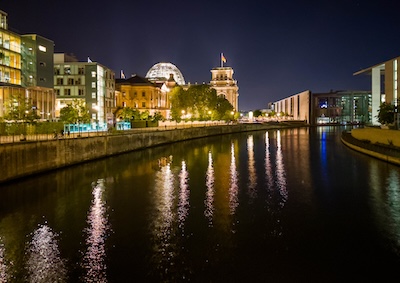
Berlin is different
The outcome in Berlin was entirely different. Alternative für Deutschland won 16 percent of the vote (up from 9 percent in 2023), but the big gain was by die Linke (the Left, reassembled from the old communist party), with 26 percent of the vote (up from 12 percent). The three established parties – the outgoing Christian Democrats, the Social Democrats and the Greens – all lost support.
The outcome will almost certainly be a Social-Democrat, Greens, Left coalition, led by die Linke. In view of the legacy of die Linke, which lies in the oppressive communist East German regime, this will be an uneasy coalition.
Berlin, because of its post-1945 history, is unlike any other big city on the planet. It would be a brave person to draw many inferences for other parts of the world from this election outcome. But the 20 percent loss of support for the established parties resonates with developments in other places.
Marcel Fürstenau, of Deutsche Welle, has a general interpretation of the elections, including their repercussions for federal politics: German elections deal a blow to Chancellor Friedrich Merz, who decided to stay in Germany rather than attending the UN General Assembly (a disappointing absence on the world scene). The Christian Democrats have been the dominant party in Germany since the country’s reconstruction in 1949, and has never suffered a loss of this scale before,
At least some of the swing in state elections seems to be a reaction against the federal government’s tightening approach to pensions and long-term health care.
Details of the two German elections are on Wikipedia for Mecklenburg-Vorpommern and for Berlin. An interactive map of the outcome by electorate in Mecklenburg-Vorpommern is at the site Landtagswahl 2026.
USA – polls and the mid-term elections
The mid-term Congressional elections will be held on November 3. That’s only five weeks off.
On the latest of his regular Late Night Live sessions, Bruce Shapiro of the Global Center for Journalism and Trauma reports on opinion polls suggesting strongly that the Republicans will lose their majority in the House of Representatives and increasingly pointing to their losing their Senate majority: Is a “blue wave” really coming”.
The general message from these polls, and from actions in Congress, is that many Republicans seeking election or re-election are starting to see Trump as a liability.
Trump’s support is tracked in a number of opinion polls. One source is The Economist regular report on YouGov polling, How unpopular is Donald Trump?, which gives a breakdown by state (important for the Senate election) and by demographic group.
Only in Idaho and Wyoming does Trump have a positive net approval, and in none of the four demographic groups surveyed (categorized by sex, age, “race” and education) does he have positive approval. His best score is among people over 65, where his net approval is around minus 10 percent. Someone classified as “Black”, with a postgraduate education, would be at the extreme bottom of the Trump approval scale.
In recent presidential elections Trump has been able to attract Hispanic voters, a socially conservative group, away from the Democrats. Shapiro’s account of poll movements and The Economist poll suggest that Hispanics have deserted Trump. Inflation, particularly gasoline price inflation, is also affecting Trump’s approval.