Real economics
How Australians are travelling – the HILDA report
The HILDA survey negates the idea that we have a widespread “cost of living crisis”, but we have a worsening problem of intergenerational inequity.
Last week the Melbourne Institute of Applied Economic and Social Research released the latest Household, Income and Labour Dynamics in Australia (HILDA) Survey. It’s an annual survey tracking the wellbeing of a cohort of Australians, that’s been running since the start of this century.
It’s what is known as a longitudinal survey, differing from but complementing cross-sectional surveys conducted by the ABS and other agencies. Think of the difference between a snapshot and a movie, or, as the authors put it:
Household longitudinal data, known as panel data, provide a much more complete picture than cross-sectional data because they document the life-course each person takes. Panel data tell us about dynamics—family, health, income and labour dynamics—rather than statics. They tell us about persistence and recurrence, for example, of poverty, unemployment or reliance on income support payments.
For example the ABS gives us timely data on the number of people who are unemployed. HILDA data isn’t so timely – data in this release takes us up to 2024 – but importantly it tells us more about people’s experience of unemployment – how long people stay unemployed, whether they drift in and out of work, what resources they draw on when unemployed, and so on. All are important questions for policymakers.
HILDA covers a vast range of topics dealing with all aspects of wellbeing, including subjects such as people’s satisfaction or otherwise with the quality of their intimate relationships. We’re actually fairly happy with the way we get on with our partners, but women are less satisfied than men.
In view of the incessant reference to a “cost of living crisis” one might have expected to find some confirming evidence in the report. It’s there, but it doesn’t paint a picture of universal hardship as so many politicians, journalists, and serial complainers suggest.
For some life is indeed getting much tougher. Roger Wilkins’ chapter on food insecurity reports that in 2024 food insecurity affected 17.9 percent of the population, up from 13.7 percent in 2020, and that single-parent families, and all families with children aged under 10 are at an elevated risk of food insecurity.
HILDA refrains from judgement and from speculation on the cause of such hardship. Any reader, however, must wonder how in a land of agricultural plenty, almost one in five can be suffering food insecurity. There is something fundamentally wrong with the way our economy distributes its output.
HILDA has a number of cross-sectional time series on incomes and financial stress. In the graph below is a plot of its time series on equivalised household income – an indicator of material living standards obtained by adjusting household disposable income by households’ needs such as the number of dependent children.
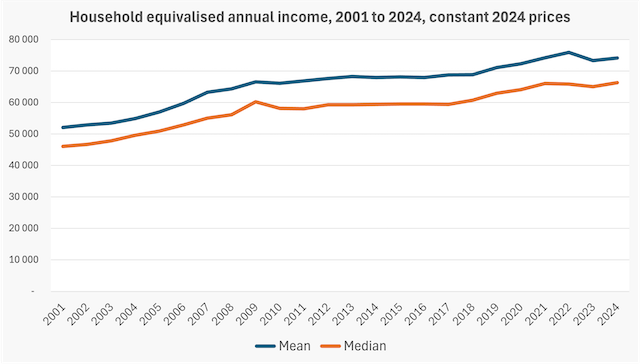
The general pattern – a period of strong growth up to the 2008 global financial crisis, flattening for nine years, another growth spurt up to a post-Covid peak, a fall and a slow recovery – is pretty well the same as time series generated from ABS data.
That similarity is most evident in the series of mean incomes which reveals that people’s income in 2024 was below its 2022 level. But people’s median income, a figure not easily obtained from the ABS, has recovered and is now above its previous levels. There is nothing in that data indicating a widespread “cost of living crisis”.
Financial wellbeing indicators, disaggregated by age, tell a more nuanced story. Panel members are asked if their financial wellbeing has worsened, stayed constant, or improved between 2020 and 2024. The results by age are shown in the graph below.
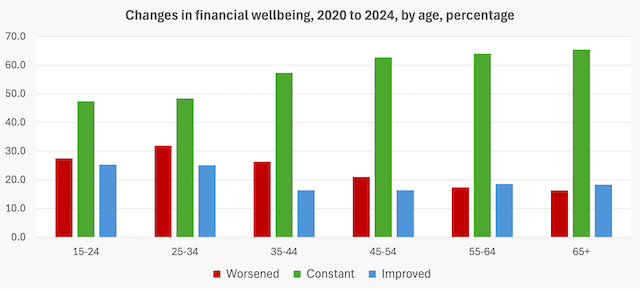
A significant proportion of younger panel members – up to 30 percent – report that their financial wellbeing has worsened. At the other end of the age scale people aged 55 or more, on balance, report that their financial wellbeing has improved. This aligns with general comments on worsening intergenerational inequity, and with what we know about housing stress.
The HILDA data generally confirms what is reported in other surveys on financial wellbeing. It’s not a general crisis: more than 70 percent (80 percent of older people) report that their financial wellbeing has been constant or has improved.
But we do see evidence of a substantial proportion of younger people, particularly those in the age groups where people are seeking to establish a family and buy a house, experiencing financial stress, confirming what we know from other sources about housing and burdens such as higher education debt that particularly affect young people.
One of HILDA’s findings confirming that stress on younger people is that more are staying at home with their parents than did in the past.
But many would be surprised by HILDA’s findings on reported housing stress: over the 24 years of the HILDA surveys housing stress has been on a flat or even slightly declining trend. Housing stress has risen in the last few years, presumably because of rises in interest rates, but that only brings the level back to where it was earlier in the century. The only group for whom housing stress has risen significantly are renters in “regions” – a confusing term used to denote anywhere that isn’t a capital city.
A group of HILDA authors have a detailed coverage of housing stress in a Conversation article: Housing stress is on the rise: 7 essential charts from this year’s HILDA survey. (The headline is misleading: Conversation contributors do not pick their own headlines).
In all, HILDA confirms what can be assembled from other data sources. Two thirds or more Australians, particularly older Australians, are coping or doing well financially. This corresponds with the findings of the recently completed Australian Resilience Index which includes financial resilience as one of its categories. But there are three partially overlapping groups – young people, renters, and people with large mortgages – who are finding life tougher that the same groups did in the past.
There is a strong partisan undertone in talk about a “cost of living crisis”, because it aligns with the idea that this dreadful Labor government, in just four years, has screwed up the economy. The harder reality to grasp is that we have an economic structure that embodies severe inequities. It’s a structure that developed over many years, even going back to the neoliberal “reforms” of the 1980s. It’s taken 40 years to develop: it won’t be undone in 4 years, particularly when even a minor initiative to make housing more affordable is met with howls of outrage from the privileged classes.
Even if HILDA reveals a generally positive picture of people’s financial stress, the same cannot be said of its indicators of our physical and mental health as reported by participants, covered in the chapter “Trends in key social and economic indicators” by Inga Laß, Kyle Peyton and Roger Wilkins.
People are reporting deterioration in their physical and mental health, most markedly by younger people, and by more women among men. People over 55 seem to be immune from this deterioration – apart from men in the 55-64 age group whose reported mental health has declined. Up to about 2010 the patterns were stable, but the declines are steep from then on. Covid appears, but only as a blip. This decline in physical health is not revealed in official data. When official epidemiological data and self-reported data differ strongly, we’re probably seeing something about people’s outlook on life.
HILDA’s chapter on education and labour market outcomes by Kyle Peyton and Roger Wilkins reveals a great deal about how Australia is changing. The gap between women’s and men’s education attainment is widening. For example 51 percent of women and 40 percent of men aged 25 to 34 hold a bachelor’s or higher degree. Among the same age group completion of Year 12 is the highest education attainment for 21 percent of women and 33 percent of men. The gender pay gap is closing, slowly. But the worst labour market outcomes are for those 15 percent of men who have not completed Year 12.
These figures on education attainment and labour market outcomes may help us understand the sources of the wave of grievance driving many Australians to the false promises of populist political parties.
The Coalition’s energy policy – a chainsaw to net zero
A spiteful rejection of green energy, without a shred of economic reality.
Liberal Party energy spokesperson Dan Tehan, in his Appalachian drawl, delivered the Coalition’s energy policy at The Australian’s Energy Nation Forum last week. The main plank is to scrap the Net Zero Cheaper Energy Act. In detail:
That means repealing the Climate Change Act, abolishing the safeguard mechanism, repealing the New Vehicle Efficiency Standard Act, revoking four offshore wind energy zones, repealing all legislative prohibitions on nuclear energy, introducing a renewable energy code of conduct, making Commonwealth energy funding to states conditional on prioritising affordability and reliability, and redirecting the Australian Energy Regulator to have primary regard to affordability and reliability.
Throughout his short speech he reinforced the Coalition’s message that high electricity bills experienced by households and industries result from the government’s energy transition policies.
That argument is getting hard to sustain when the Australian Energy Market Operator (AEMO) in its latest Quarterly Energy Dynamics review reports falling wholesale prices:
NEM‑average wholesale spot prices averaged $74/MWh, down $66/MWh (-47%) from Q2 2025, and the lowest Q2 average since 2020. Increased renewable generation, higher grid-scale battery discharge during peak periods, and reduced evening peak demand contributed to lower wholesale prices and a flatter intraday price profile.
Keep the coal fires burning
That means that only 6.6 cents of the 30 to 35 cents you pay for a kWh of electricity is for generation, such has been the success of solar and wind power, supplemented by batteries, in suppressing energy prices. The rest of your bill is in transmission, distribution and “retailing” – all functions for which we pay far too much as a result of having privatized our electricity utilities.
To his credit Tehan does acknowledge that there have been excess returns to transmission companies, but he puts this down to their need to cater for renewable energy, rather than the generosity of our regulators to the mostly foreign owners of these assets, who are allowed to enjoy monopoly profits from highly-geared financial structures.
Tehan is undaunted in his assault on renewable energy, and while he simply mentions coal as a possible fuel, his Coalition colleague David Littleproud goes one step further, calling for a new coal-fired power station to serve a data centre in Queensland.
It is notable that Tehan’s announcement includes the revocation of four offshore wind energy zones. Offshore wind, if distributed across enough coastal regions, complements solar power well, because sea breezes develop in the late afternoon, as solar output is waning. The alternatives to offshore wind are batteries – for which the Coalition has no appetite, and gas.
A summary of the politics behind the Coalition’s announcement is in Peter Hannan’s Renew Economy article: Coalition’s pursuit of Agent Orange climate policies will deliver an investment apocalypse soon enough. “Presumably the plan is to save the electricity sector by first laying it to waste” he states.
Another who summarises Tehan’s announcement is the ABC’s Jake Evans. He points out that just three years ago Tehan was a strong supporter of offshore wind and is now disowning wind: Coalition vows to “take a chainsaw” to climate laws and offshore wind.
But three years ago the Liberal Party was not in competition with One Nation to secure the anti- renewable energy vote.
The Coalition doesn’t have to align itself with Pauline Hanson. It should be able to find plenty of ground to criticize the government for its energy and climate change policy without endorsing One Nation’s idiocy. For example Hannan is highly critical of the government for its reliance on land use as a path to net zero. The Grattan Institute’s Tony Wood points out design weaknesses in the electricity sector’s Integrated System Plan, and weaknesses in the AEMO’s governance arrangements: Australia needs a better energy system plan. And the government is wide open to criticism for its hypocrisy in promoting the export of fossil fuels while pursuing net zero domestically.
Tehan says “we need to take a chainsaw to Labor’s green ideologically driven approach to energy”, without identifying that ideology, which seems to be based on the fundamental rules of economic efficiency. It’s Tehan’s side of politics that has been captured by some ideology that sees our energy transition in terms of identity politics, or as some sort of woke project.
Most business hardheads will probably ignore the Coalition’s idiocy. As Giles Parkinson points out in Renew Economy, in spite of the Queensland government’s “ideological hatred of clean and cheap energy” (quoting Murray Watt), investors are powering ahead with wind and solar projects in that state.
There may be more to the Coalition’s strategy than simply chasing the One Nation vote. In promising a dramatic reversal in policy it is possibly trying to damage investor confidence in clean energy in Australia. It would be convenient if it could go to the 2028 election criticising the government for stalled investment in renewable energy, and even more convenient if that means there will have been inadequate investment in renewable energy to bring about a significant reduction in power prices. Consideration of the national interest has never dulled the Coalition’s sense that it is the only political party that should be allowed to hold office in Australia.
Tax reforms – even property speculators benefit
The government’s tax reforms announced in the budget actually lower taxes for many investors, but a campaign of lies and misinformation has led people to believe otherwise.
Ask most people how they see the government’s capital gains tax changes, and they will probably say that the government raised taxes for investors.
That is wrong, as was pointed out at the time by detached commentators on those reforms, including in these roundups. The reforms actually mean that capital gains taxes on high-growth investments are higher, and are lower on those investments that show modest growth in value. The reforms mean that taxes are levied only on real capital gains, not on the illusory gains of inflation, restoring a measure of neutrality to capital gains taxes, as was the way capital gains taxes worked before prime minister Howard yielded to lobbying by the finance sector..
One can hardly blame people for their misconception. At the time of the budget social media were awash with the voices of “influencers”, ignorant of finance and paid to promote the Coalition’s line. Overworked journalists, with little knowledge in finance and little time to check the facts, repeated the line that the government was raising taxes,
Elyse Dwyer and Nicholas Garvin of e61 have done microsimulation studies, addressing the question How many housing investors pay more tax under the reforms?.
In all, they find that the tax changes are favourable to most housing “investors”. Among their findings are two specifically relating to capital gains taxes:
The reforms lower CGT for the majority of investors. Most past capital gains have been below the threshold at which the 50% discount is more favourable. The CGT changes move taxes more than the negative gearing changes.
and
Relative to the 50% CGT discount, the inflation deduction lowers tax for low realised capital gains, and lifts it for high realised capital gains by more. This is a more equitable system and also means that:
(a) government tax revenue rises substantially, because the higher tax revenue on high-return investments more than offsets the lower revenue on low-return investments; and
(b) the reforms make housing investments less risky for investors; that is, the variance of after-tax returns declines.
It is notable that their modelling applies to housing. But the same logic applies to investment in equities. Those investors who have the luck to ride on a speculative wave before it breaks will pay more tax, while more conservative investors who invest in exchange-traded funds and listed investment companies will pay less tax. The reforms make the share market a safer place for long-term patient investors, and a less exciting place for financial cowboys.
But the hype about the government’s oppressive taxes hasn’t stopped. Typical of the reportage is an article in realestate.com.au: $750k “golden visa”: Aus landlords flee to tax-free offshore mansions. The United Arab Emirates has become the place for “young entrepreneurs, very talented Australians.” they write. “People of wealth and success are moving. They are fleeing”, enticed by low taxes and golden visas for those who invest 2 million Dinars (about $A750 000) in property in the Emirates.
Older Australians who have knocked around the Middle East may recall the days when Beirut was the go-to place for property speculators. The UAE is unlikely to suffer the same fate – it has less belligerent neighbours – but its ongoing prosperity is far from assured. Hopefully these speculators will make use of their golden visas and stay in the Emirates: we don’t need them back in Australia.