Politics
America has voted – what does that mean for Australian politics?
Although its political systems are very different from ours, America’s election has messages for our own political classes, particularly the political consequences when voters believe that the economy is not serving their interests.
America’s strange democracy
Australians and visitors from other democracies can be bewildered by America’s politics. While the world’s attention is on the nation’s federal politics, Americans they meet are more likely to be passionately engaged in local campaigns for the school board or the chief of police, and are relatively uninterested in national issues.
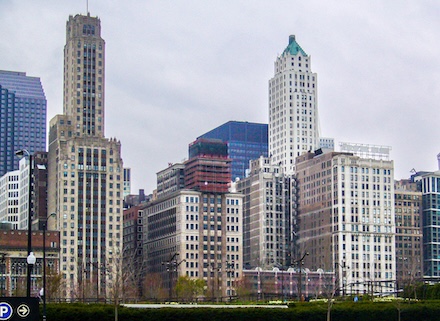
Chicago – 80 percent Democrat
That’s the legacy of a nation built as a bottom-up federation, 125 years before Australia, when to most settlers Washington was a remote and isolated place with little connection with their daily lives. As an early adopter of democracy, America suffers something of a first-mover disadvantage. In that context the relative autonomy of states in setting electoral boundaries and establishing voting rules is understandable, even if we see it as a democratic weakness.
Less easily understood is the durability of its two-party system, particularly at a time when in other democracies support for the two-party system is collapsing. Constitutionally its Senate voting system, which involves each state voting for one senator at a time, leaves no room for non-establishment parties (our states elect 6 senators at a time on a proportional representation system).[1] That’s the only constitutional bind: for the most part the two-party system is supported by long-standing conventions, including first-past-the-post voting, and the established primary system. Interviewed on the ABC’s Saturday Extra last weekend, Democrat strategist Doug Sosnick describes the US party system as “calcified”: What next for the Democrats?.
In a country that valorises choice, where you can be offered 336 varieties of pizza, or a bewildering variety of vehicles at an airport car rental bureau, the binary Democrat-Republican offering appears to be out of keeping with the national culture.
Ava Kalinauskas and Samuel Garrett of the United States Studies Centre have a guide to the 2026 US midterms. They explain the mechanics and politics of the midterms, and they remind us that there are many state ballots that occur at the same time as the federal midterms.
Writing in The Conversation Robert A Strong of the University of Virginia explains what happens after a midterm tsunami. The general pattern is that Democrat Congressional victories are generally accompanied by expectations of liberal or progressive reforms, but the outcome is usually more conservative.
The Democrat tsunami will have worldwide political, economic and security consequences, but it is my intention in this post to focus on how it will influence the way we do politics in Australia.
What happened on November 3
America desperately needs an Antony Green or Casey Briggs who can explain it all simply. The closest they come to such talent is NBC’s Steve Kornacki, whose clear explanations and use of a big touchscreen take viewers on an election night analytical journey. Bookmark his site for your presidential election party in November 2028.
There is no shortage of well-explained websites explaining what has happened in individual states, particularly where there were big upsets, but it’s hard to find clear and concise national explanations. That probably reflects the local focus of American political life.
With the detachment of observation from the outside, Britain’s BBC (that country’s public broadcaster) has an explanation: How America voted in maps and charts. So does The Economist in an article The Democrats’ extraordinary triumph, explained, but unfortunately it’s behind their paywall.
The popular vote outcome for the House of Representatives was Democrats 55.8 percent Republicans 42.7 percent, an 8.6 percent swing to the Democrats. This is more than the usual midterm swing against the president’s party, and is only a little stronger than the pollsters were predicting. Nevertheless it seemed to take many by surprise. Republicans could bring themselves to believe they had been so badly defeated, and many Democrats had braced themselves for disappointment.
Wherever there is voluntary voting (i.e. in most of the world’s democracies) turnout is an important political indicator. Recent European elections have been characterized by surges in voter turnouts, but while turnout for this midterm has been high by US standards, there is no evidence of a surge. Turnout was around 49 percent, about the same as the 2018 and 2022 midterms, but higher than the 40 percent or so in the pre-Trump era.
As usual, there was high state-by-state variation in turnout, ranging from 33 percent in West Virginia up to 66 percent in Maine. Turnout was low in poorer states, and was also low in states where there was unlikely to be any change in representation, such as Hawaii, where it was only 38 percent.
These gross figures, however, mask considerable dynamism in the electorate. The Economist’s analysis looks at those who voted, or didn’t vote, in the 2024 presidential election and sees how they voted in the recent midterms. Many who didn’t vote in 2024 turned out to vote in 2026, and their votes strongly favoured the Democrats. A few who voted for Trump in 2024 voted for the Democrats this time, but a much larger group just didn’t bother to vote. Turnout, rather than conversion, explains most of the outcome.
Within these figures is evidence of an unusually high turnout of young voters, explained in a Conversationcontribution by Sara Suzuki of Tufts University: Young people turned out in near‑record numbers for the 2026 midterms, with the economy top of their minds. Her analysis shows that two-thirds of voters aged 18 to 29 voted for the Democrats. (We might wonder how they may have voted had there been greens on the ballot paper.) Among young people and among voters generally, women were much more likely than men to support the Democrats.
There was a high turnout among “black” voters, particularly in the southern states, which helps explain outcomes such as the extraordinary Democrat victory in the Mississippi Senate contest.
Worldwide there are signs of a revision of political consciousness among young people and among minorities who have previously been politically disengaged – in Serbia, Israel, in Germany (nothing motivates the young as well as talk of a military draft) and in France (where there are echoes of the unrest of 1968). America seems to be participating in this trend in a quieter way.
It is also clear that many Hispanic Americans have switched back to support the Democrats, which goes some way to explain the Democrats’ extraordinary success in Texas. Parties on the liberal-left have tended to assume that they will pick up support from ethnic minorities, but that’s a dangerous assumption, because some minorities, including Hispanic Catholics in America and Muslims in most countries, tend to be socially conservative and can be drawn to parties on the right. In America the Democrats may owe much of their success to the brutal idiocy of ICE agents.
It will be some time before researchers, using large data models and multivariant analysis, generate their analysis of voting patterns. A Gallup survey in October – The issues voters say matter most to them – captures the pre-election sentiment. Its main findings, combining “important” and “extremely important” responses are shown in the graph below.
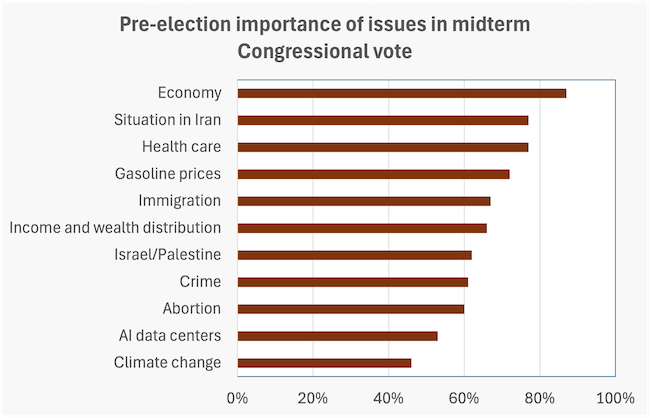
It is notable that voters are polled separately on Iran and on Israel/Palestine issues: they are not lumped together as “Middle East”.
For all these issues Gallup separates the responses of Republican and Democrat voters. On most issues surveyed, particularly health care, income and wealth distribution, and climate change, Democrats are much more concerned than Republicans. Only on immigration and crime are Republicans more concerned than Democrats, but the difference is small.
That’s all pre-election polling. The company SSRS complements this with a blend of pre-election polling and exit polls, that cover voters’ main six issues.
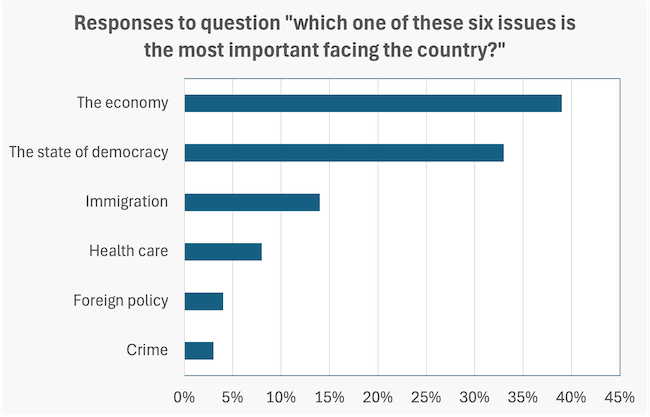
In this presentation it is notable that only 4 percent of voters identify “foreign policy” as a decisive issue, even though most of the damage Trump has inflicted on the American economy can be attributed to his capricious foreign policy ventures, particularly his use of retaliatory tariffs and the war against Iran. These concerns show up in the classification “the economy”.
If Americans are disregarding the relationship between high prices and Trump’s foreign policy, it is little wonder that in Australia the Coalition and its backers in the Murdoch media are laying the blame for our high prices on the Albanese government, with some success. William Bowe’s Poll Bludger, reports on the most recent Resolve Strategic Poll, that finds 42 percent of Australians blame our government for rising prices, while only 26 percent blame global factors outside our government’s control.
In some more detailed analysis SSRS reveals that in the US “the cost of living” is “crucially” important for most voters aged 18 to 44, and that “government corruption” is almost as important. Younger voters were particularly concerned “to express opposition to Donald Trump”, and NBC exit polls indicate that 43 percent of voters saw the election as “a rebuke of President Donald Trump’s performance”.
“Corruption” has many meanings in politics, ranging from favours to mates through to its use as a metaphor to describe the deliberate weaking of institutions and abandonment of moral standards among the political class. On last Monday’s Late Night Live – How will Democrats use their new power? – regular American commentator Bruce Shapiro was clear that in his view that voters are increasingly disgusted by the poor moral standards of Trump and the people around him.
SSRS also provides some data on voting outcome by demographic group, and by what Americans call “race”. The percentage Democrat vote is shown in the list below. (The balance, apart from a one or two percentage vote for “other“, is for Republicans.)
- Community size: urban 72%, suburban 59%, rural/small town 41%;
- Age: 18-29 73%, 30-44 62%, 45-64 52%, 65 and over 50%;
- Education: college graduate 63%, no college degree 48%;
- Gender: male 50%, female 59%;
- “Race”: white 49%, African American or Black 90%, Hispanic 64%, Other 62%.
In terms of demographic trends the Democrats are in a stronger position than the Republicans.
One issue with which Australians may identify is the construction of data centres. Writing in The ConversationBarbara Trish of Grinnel College, Iowa, describes how in some states pushback against data centres has been an important issue in the midterms. Opposition is stronger among Democrat supporters (69 percent) but it is also strong among Republican supporters (54 percent). As in Australia the specific issues concerning data centres include their demand on electricity and water. In a Conversation article Johanna Lim and Olivia Shen of the University of Sydney discuss the political implications for Australia: US voters lashed out at data centres. What does that mean for Australia’s AI ambitions?
One item prominent in people’s concern with the cost of living is gasoline. In the US the average pump price of gasoline at the time of the election was $US4.00 a “gallon”, or about $A1.50 a litre (poor dears!). Because gasoline is so lightly taxed, changes in the wholesale price show up as relatively large percentage swings in the retail price. That $4.00 is up from about $2.80 before Trump went to war with Iran.
Between states there are large variations in gasoline taxes and charges: gasoline has been particularly cheap in the southern states, which means that the effects of higher crude oil prices have been particularly noticeable in those states.

Blame Trump if you can’t afford to run it.
A notable feature of this election was campaign spending in Texas, where the Republicans, boosted by a massive $US212 million donation by Elon Musk, spent $US316 million defending Senate candidate Ken Paxton.
It didn’t work: the Democrats won the Texan Senate contest with 55 percent support.
In a Global Roaming session – Is the US midterm result a win for “normal Americans?” – Geraldine Doogue and Hamish Macdonald interview Republican political strategist Dane Waters about the failure of this spending to influence the outcome. Doogue suggests that the influence may even have been negative, because it exposed the scale of Paxton’s support from the ultra-rich. Dane, however, suggests that it would have been effective had the Republicans chosen a more suitable candidate. Doogue could also have mentioned Clive Palmer’s remarkable failure to buy political support.
Political parties and independents clearly need money to mount a campaign, but it is almost certain that there are diminishing returns to increased spending – or even negative returns once a level is reached. And an arms race can develop, as was the case in Texas, where the Democrats spent $US146 million in response to the Republicans’ $US316 million. This outcome supports the case for legislated spending caps, because the Texan arms race was costly for both parties.
In Australia’s case it is possible that the big parties engage in unproductive spending sprees, while small parties and independents focus on issues of concern to electors.
What the election means for Australia
An optimist would point out that Americans have demonstrated to the world what happens when people elect a right-wing populist government. There should be enough of a demonstration effect to turn people away from One Nation and to force the Liberal Party towards the centre – or to die a dignified death.
A less optimistic interpretation is by former Victorian Labor Party minister Philip Dalidakis, writing in the Financial Review: MAGA is not dead. Republican voters didn’t turn out at midterms. Had they turned out to vote the outcome would have been very different, and in Australia compulsory voting rules out the option of Liberal and One Nation voters staying at home. A One Nation vote may be our form of political disengagement.
The most powerful message is that economic hardship, whatever its cause, results in people turning against the party in office. That will no doubt provide some encouragement to those on the right. Ian Verrender points this out in his post Why cost-of-living concerns are upending global politics.
Noting that many voters have been motivated by an anti-Trump sentiment, even though it was not a presidential election, Liberal and One Nation strategists, and their supporters in the Murdoch media, seem to be united in an anti-Albanese strategy, in the run-up to the Victorian and New South Wales state elections.
It’s a lazy, miserable and morally indefensible approach to politics, which may yield some short-term gains for the Liberal Party, but with long-term costs. If they look past the short-term opportunity to benefit from our “cost of living crisis” (a misnomer for structural inequality), those same strategists might become more aware of their own mortality. Demographics are not on the side of parties whose base is dominated by the aged and unschooled. Note how in America the Republican vote is concentrated among the less educated, the aged, and those who live in non-metropolitan regions.
But they don’t seem to have any long-term plan because, according to Karen Barlow’s reporting in the Saturday Paper, the Liberals cannot agree whether to become more MAGA (Dutton’s failed strategy), to follow One Nation’s emphasis on the size and composition on immigration (didn’t do much for the Republicans), or to continue to delegate policy to the National Party, even though it will probably disappear as One Nation solidifies its rural hold. Missing from Barlow’s list is a move towards the political centre (they drove out Sussan Ley for thinking that way) or the development of a coherent economic policy. They are still burdened by a belief that all that counts in economic management is the fiscal balance.
As for the Labor Party, its strategists will surely be poring over the results in contests where the Democrats put up progressive candidates, such as in Michigan, where party old-timers warned against a swing to the “left”. So far there is no evidence that proposals for what Americans call “left” policies – such as universal tax-funded health care – cost the Democrats support, but it will be time before studies reveal how such policies influenced voters.
It is clear from the US election that the Republicans were caught off-guard by big swings where they didn’t expect them. Even their attempts at gerrymandering failed (in fact extreme gerrymandering can backfire). The idea of a “marginal seat strategy” is surely past its use-by date, particularly in a multi-party system.
As for other parties and independents, there’s not much the US system can tell us. From here the US looks like a political system that can deal with conflicting views only through political polarization, entrapped by a constitution written a quarter of a millennium ago, and by a massive investment in a two-party system. That should serve as a warning about the folly of trying to prop up a failing system, and allow us to make the most of our institutions that support multi-party representation, including our Senate elected by proportional representation and our use of ranked-choice (preferential) voting.
At first sight the US system seems to have entrenched the two-party system. But consistent low turnout for Congressional elections – 50 percent or lower – carries much the same message as support for independents and new parties in other democracies. In rough terms The Republicans and Democrats each enjoy about 25 percent support (50 percent of 50 percent). That’s about the same as the primary vote support for the Coalition and Labor.
Over the next two years the world will be looking anxiously at Trump’s behaviour and his relationship with Congress, amazed at the power of one person in a democracy whose creators believed that a constitution, based on Enlightenment values, could curtail the power of a madman. So far there has been a huge range of speculation about how Trump will behave in the remainder of his term. Whatever the outcome in the US we should ensure that our own constitutional practices and our parliamentary conventions support the primacy of parliament and do not allow us to drift, de facto, into a political system of elected dictatorship.
1. There is the occasional exception, such as independent Senator Bernie Sanders but these generally have their origin in the established parties. ↩
On golf clubs and military barracks
The Albanese government pays a political price for its lack of a clear idea of the public purpose.
Albanese has copped justifiable criticism for his part in a $6 million grant to a golf club in his Marrickville electorate. He has also been criticised for initially allowing the Defence Department to sell off heritage military barracks, a decision on which he has had to back down.
In the case of the golf club, there is no imaginable principle of public expenditure that could justify public funding. A golf club, particularly in a relatively prosperous region like Marrickville, is what economists call a “club good” – a shared good that people can finance for themselves.
But there is a case for public funding of national treasure, including colonial-era military barracks. As the flood of protests has revealed, people value these assets, and seek to keep them in public hands. Even the Americans, ideologically disinclined to public ownership, would not consider selling heritage military buildings. Because of their historical significance Australians want these buildings to be preserved for public enjoyment or at least to retain their function as military facilities.
As philosophers such as Karl Polanyi point out – and as is understood by most people – societies make choices between what is included in markets and what is excluded from markets. Over the last 50 years however, with the rise of neoliberalism, governments, initially on the right, but over time all governments, have ridden roughshod over society’s preferences, and over principles of economic allocative efficiency, forcing privatization whether people want it or not.
The government could have avoided the political embarrassment of both incidents had its decision-making been guided by a clear idea of what should be in the public sector and what should be left to the private sector. The economic boundary is defined in standard text books on public finance – and in books written for non-economists such as Miriam Lyons and my 2015 work Governomics: can we afford small government?
We might expect a social-democratic government to interpret that boundary in favour of the public sector, and to be consistent.
The Albanese government is not the only government to be caught out by the inconsistency of its decisions regarding the public/private boundary. Coalition governments have paid a political price for unjustified boondoggles involving car parks and shooting clubs, and Labor governments have paid a political price for costly privatizations, such as the Beattie state government’s privatization of electricity distribution. In Britain the Blair Labour government did itself and the nation no favour with its “third way”, which involved a little socialism here, a little free enterprise there, without any consistent principles that could be understood by the public (and even its own ministers).
The problem seems to lie in a cabinet process, formalized by the Hawke-Keating government and followed by all subsequent administrations, that prioritises short-term fiscal considerations in bidding wars between ministers, without the discipline of a clearly-defined idea of the public purpose.