Politics
Comrade Pauline?
Much has been written about One Nation’s tactics and policies. John Birmingham’s Quarterly Essay is a study of the concerns of the party’s supporters, and finds a yearning for a Labor agenda of past times.
After reading John Birmingham’s Quarterly Essay – Another country: the rise and rise of One Nation – you might have to revise any tendency to classify One Nation as a movement on the right, because Hanson’s followers seem to be yearning for something that looks like a Labor government of the past years.
That is the Labor government we never elected, headed by Arthur Calwell, in the days of secure and full employment, tariff protection and White Australia, but not the disruptive Labor governments of Whitlam or Keating.
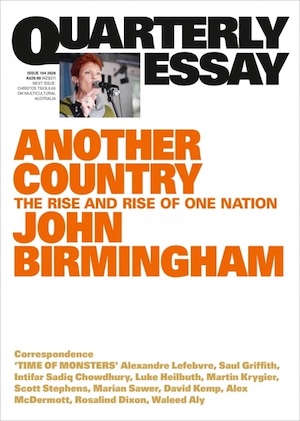
Birmingham describes this nostalgia that many One Nation supporters hold, even if they cannot articulate it. It’s not too specific, because to pin it down would mean confronting the unpleasant realities of past times – brutal and dangerous working conditions in many industries, religious bigotry and racism, high crime rates, particularly domestic violence, and for many the sort of poverty that saw kids in school photos without shoes.
Birmingham helps us to distinguish between One Nation’s ruling troika – Hanson, Joyce and Ashby – and the millions attracted to the movement. One Nation’s voting record in Parliament on matters affecting workers’ conditions would put the party on the hard right of the political spectrum. So too would its links to Nazis, through the March for Australia movement.
But the party’s followers yearn for that imagined Australia – an Australia where governments did stuff for people. These were the days before privatization took hold, when governments provided electricity, ran employment services, built housing, owned airlines. It was an age when we were more equal – when the bosses may have had newer cars and lived in bigger houses, but there weren’t the extreme divisions we see today.
That presents a problem for One Nation as it has developed, because as Birmingham writes “harvesting a protest vote against the ruling elites is easier from a fish-and-chip shop out the arse end of Ipswich than it is from Gina Rinehart’s private jet.” But if the National Party has been able to persuade people in the bush to vote against their interests for the last 100 years, it shouldn’t be too hard for One Nation.
By Birmingham’s account, which aligns with other findings, One Nation’s main followers are those who respond to political polls in their strong agreement with the statement that “Australia is off on the wrong track”. According to Essential polling, in 2022 only 27 percent of Australians believed Australia is off on the wrong track; now there is 61 percent agreement.
Although it’s often cited in the media, it’s a pretty useless survey finding, because it tells us nothing about where people think the right track lies.
Birmingham tries to find out what One Nation supporters really want with little success, but he does find what they don’t want, and in a nutshell it’s the social and economic order delivered to us by neoliberalism – although those aren’t the exact words used by Hanson’s fans in an Ipswich pub. They don’t like the marketization of everything, the parasitic growth of the finance sector, the dominance of big business, the ostentatious manifestations of inequality, the commodification of labour.
These feelings are not confined to Birmingham’s schoolmates in Ipswich. As Ian Verrender explains in his post The dark forces driving discontent across the developed world:
The compact — the unwritten agreement — between workers and the democratic state is fraying. Lower- and middle-income workers feel they're going backwards. And they're not imagining it. Wages have not kept pace with inflation as asset prices have soared. Property ownership in many Western nations is almost out of reach of ordinary workers, while rents have skyrocketed. That has concentrated wealth in an increasingly smaller cohort of wealthy households.
And the response by governments? Higher interest rates and fiscal austerity, worsening the pain for the disadvantaged and widening the wealth and opportunity gap even more.
Here we have one part of the explanation. People are pissed off with what politicians have delivered. They feel particularly betrayed by Labor as it has become, but like voters in other democracies they are turned off by both the established parties.
In this context we can see One Nation in the same pattern as other insurgent movements – the Bolsheviks in Russia, the clerics in Iran, MAGA in America. It is harnessing people’s grievances in order to overthrow the existing political system and replace it with a new, and more oppressive system, with privileges for the new class of elites.
But unlike Lenin, comrades Hanson, Ashby and Joyce don’t have a clear vision to give their followers, because neoliberalism has completely colonized the arena of public ideas. A quarter of Birmingham’s essay is in a section titled “Mont Pèlerin”, a reference to the physical location of where Friedrich Hayek and his followers gathered to hammer out the basic principles of neoliberalism. Birmingham describes their political philosophy:
Hayek, Friedman and their fellow travellers wrote the theology. High-wealth individuals and corporations funded the holy war through hundreds of free-market think tanks, indoctrinating generations of politicians on both sides of Parliament and congresses in a laissez-faire pseudo-science. The consequences were many: privatisation, union-busting, wage-suppression, tax cuts for the rich, welfare cuts for the poor. Service cuts for everyone else.
Although they influenced the ideas of Reagan and Thatcher, their work was more in line with that of the Marxist Antonio Gramsci – in fact they probably were well familiar with his work. Don’t bother trying to influence politicians; establish the basic messages of neoliberalism in the public mind, so that anything else becomes unimaginable.
Perhaps these messages can be summarised in a set of “everyone knows” statements. Everyone knows that the private sector always does a better job than government. Everyone knows that we are being overrun by immigrants. Everyone knows that policies to protect the natural environment result in lower living standards. Everyone knows that refugees sponge on the welfare system. Everyone knows that social-democratic governments can’t handle the economy. And so on. Some ideas are kept out of the arena altogether, as we saw last week at COP31, with the determination of big oil to avoid any mention of phasing out fossil fuels, precipitating a dispute that derailed any chance of achieving an agreement. Just as reasonable people would not entertain the idea of advocating the use of nuclear weapons, or support trafficking in child labour, they would not consider a future without oil and gas.
Academics, concerned citizens and the occasional policy wonk may challenge these ideas, but their voices are effectively muzzled by those with the funds to pursue libel cases and hire compliant journalists, and with the connections to intimidate public broadcasters.
The dismal trajectory is for One Nation, either on its own, or through its influence on the Liberal and National parties, to establish enough power to transform Australia into a MAGA-style oligarchy. That’s a re-play of the old tactic of far-right parties to persuade people to vote against their self-interest.
But Birmingham doesn’t see that path as inevitable, because there are other forces. Young people are experiencing the same deprivations, and are expressing the same grievances. Throughout mainland Europe, from Germany to Serbia, young people are taking to the streets in mainly peaceful but loud protests: these movements have an air of 1968. The young have no memory, not even an imagined memory, of some white workers’ paradise back in the never-never. Young, educated people are turning to the Greens in the same way as older less educated people are turning to One Nation, and demographics are on their side.
Here may lie an opportunity for Labor, if it has the courage to overcome its extreme risk-aversion and fear that something it says about unfairness and undeserved privileges for the rich may upset Tim Wilson. There is a heap of junk in One Nation’s policies, that have been made on the fly. But viewed from the perspective of One Nation’s followers, rather than the perspective of its governing Troika and rich financiers, some could fit with a Labor agenda for re-building public sector capability and making the tax system fairer on workers.
On the former, a Labor government could remove private corporations from employment services, aged care, disability care, child minding and early childhood learning. The profit motive and the standards reasonably expected in these activities are not compatible. It could place more public servants into outer-suburban and non-metropolitan regions, with the delegated authority to make timely decisions. It could show that it is willing to stand against big business, including the gaming and professional sporting lobbies, when their behaviour is detrimental to the public purpose. It could use its financial leverage to push state governments to direct public infrastructure to investments with high benefit-cost outcomes, and to abolish toll roads.
On the latter it has made steps towards tax reform, but it seems to be apologetic about its progress in making housing more affordable and in making the share market more friendly for long-term patient investors. And people hardly know about the way it has shifted the tax scales at the bottom end.
Labor can take on many of the grievances of One Nation’s followers without turning to racism, xenophobia or protectionism. For that matter, so too can the Coalition, or at least the Liberal Party, which has let the National Party – One Nation lite – determine so much of its policy agenda. If it recognizes One Nation’s surge as a rejection of neoliberalism, it will drop its destructive platform of gutting public sector capability.
Birmingham’s essay is summarized in a Conversation Friday Essay by Matthew Ricketson of Deakin University: Nostalgia or neoliberal collapse? – John Birmingham investigates Pauline Hanson’s appeal. It complements Birmingham’s work in that he links to much that has been written since Hanson popped up on the political scene 30 years ago, such as Margo Kingston’s 2001 book Off the Rails: the Pauline Hanson Trap.
You need to go into Birmingham’s essay to understand the world of One Nation’s supporters. He describes that world in such a way that only an accomplished novelist can, while drawing on hard data to illustrate his theme. And his cover of neoliberalism from its roots in the Mont Pèlerin Society is masterful – well worth reading even if you think it’s a waste of time to read about a political movement that’s peaked and is on its way to oblivion.
The Scanlon survey reveals Australia’s outstanding multicultural strength
The latest Scanlon survey paints a picture of a robust multicultural Australia, and rebuts the idea that a “cost of living crisis” has arisen, but there are signs of declining social cohesion.
One of the most heartening findings in the Scanlon Foundation’s 2026 Mapping Social Cohesion report is that “only 9 percent of survey respondents said that it was greatly important to social cohesion that ‘people come from similar cultural backgrounds’ and only 12 percent said that it was greatly important that ‘people agree with each other on big social issues’. Even One Nation supporters are “much more likely to say that happiness, safety, belonging and respect, despite our differences, were important to social cohesion”.
We overwhelmingly agree (87 percent) that “an immigrant can make just as good a citizen as the Australian born”, and those inclusive views are held by the native and immigrant population alike.
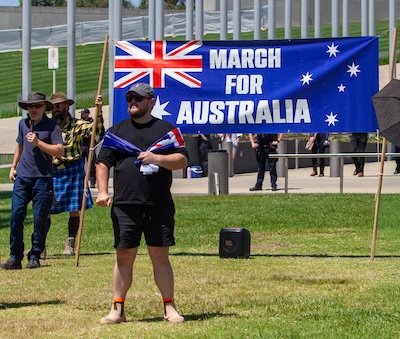
Some prefer a white and British Australia
But within those broad findings there are some concerning negative indicators. While we feel pretty happy with people of Christian, Jewish, Hindu and Sikh faiths, and have an extremely positive attitude to Buddhists, we don’t feel so positive towards people of Islamic faith: 43 percent of respondents have a negative attitude to Muslims while only 14 percent have a positive attitude, and those attitudes have hardened in the last few years.
Most respondents, particularly older people and people with limited education, believe that social cohesion is declining, and around half are pessimistic about Australia’s future. One Nation supporters are particularly gloomy. The Scanlon index of social cohesion has been on a downward trend for 20 years, apart from an upwards blip during the Covid pandemic. Separate surveys of pride and belonging in Australia have been on a downward trajectory, but have lifted somewhat in the last two years.
Trust in the Commonwealth Government is low and falling. It is particularly low among One Nation supporters; only Labor supporters have high trust in government. These results suggest that surveys in trust in government are really about partisan attachment.
Nevertheless we are reasonably satisfied with parliamentary democracy (90 percent like “a democracy, in which members of parliament are chosen in an election”, but 21 percent like the idea of “having a strong leader who does not have to bother with parliament and elections”.
Most revealing, because of their departure from common beliefs, are indicators of financial hardship. There are breaks in the series, and the temporary boost in income during the pandemic is evident, but it is hard to find in the indicators that go back 20 years anything confirming the common idea that financial hardship has worsened, or that we are experiencing a “cost of living crisis”. Some are struggling to pay bills, and going without meals, but there is no discernible trend in these indicators.
That is not to say all is well: in a bountiful country like Australia it’s a disgrace that 13 percent of adults “often or sometimes went without meals because there wasn’t enough money for food”. But the idea that the election of a Labor government has precipitated a “cost of living crisis” is a myth promulgated by journalists who don’t bother to look at data and by politicians hoping the voting public will believe them.
One notable finding in the Scanlon survey is that 21 percent of respondents “often or sometimes could not pay for medicines or health care over the last 12 months”. That probably explains why the government has announced a continuation of $25 PBS prescriptions, while its general message is about austerity.
One Nation’s waning (tumbling?) support
Opinion polls show One Nation’s support is slowly falling: Victoria’ election will test its support more rigorously.
Normally at this point in the election cycle there is very little polling, but not this time, and much has to do with the prominence of One Nation in the South Australian state election and in the Farrer federal by-election, and now in the Victorian election campaign.
Opinion polls reveal that One Nation’s national support peaked around June at about 30 percent. Many commentators believed that as people came to understand One Nation’s policy weaknesses, its support would quickly fade from then on. But its support has held up remarkably well.
It’s hard to find a reliable tracking poll. For a couple of months Roy Morgan had an excellent weekly poll but they dropped it. As a second-best, drawing on Wiliam Bowe’s BludgerTrack, I have looked at the figures from those five companies that conducted polls in June and November. Their results are presented in the table below.[1]
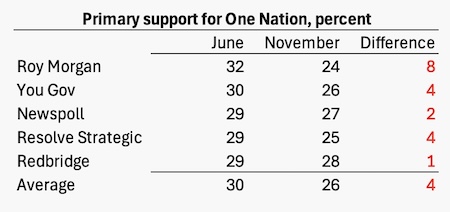
There are hints in Bowe’s data that One Nation support fell away fairly quickly before rising again. Essentiialhas a number of sample points up to October, suggesting that One Nation’s support fell from 28 percent in June down to 23 percent in September, but subsequently recovered to 28 percent.
Opinion polls offer a costless way for people to express a grievance. It will be informative to see how the party performs in the real test in the Victorian election today. One might reckon that when people vote they make a more informed decision than when they respond to a pollster, and that therefore One Nation’s vote will be lower than the polls have were showing at the early stage of the campaign. The latest Newspoll and Demos AU polls show a sharp drop in support for One Nation. Newspoll has One Nation’s support at 18 percent; Demos AU has it at 16 percent. But that’s still substantial support, enough to give the party a strong role in the Legislative Council where they could have substantial blocking power.
In all, the Victorian election will be a tough test for One Nation, because it will be contesting a number of urban seats in Melbourne, similar to those Adelaide seats where it did poorly in the South Australian election. Its confidence has been boosted by an easy run in the Farrer and Secret River by-elections, but these seats have demographics ideally suited to One Nation.
If One Nation’s support in the opinion polls translates into real electoral support, that may be because the Coalition, and Labor to a lesser extent, have legitimized One Nation’s policies, particularly in confirming the impression that they have shaped their migration policies in response to One Nation’s proposals. And the Liberals in Victoria have given One Nation and the Greens a last-minute break by announcing their most unpopular (and economically irresponsible) cuts a day before the election. We can expect to see a significant difference between pre-poll votes and voted cast today.
1. In the table Roy Morgan’s figures are rounded for presentational consistency: they are actually 31.5 and 23.5 percent. The average figure is unweighted: I also calculated an average weighted by pollsters’ sample sizes (all between 1200 and 1800), and the difference was negligible. ↩
Strange findings in Essential’s poll
The latest Essential poll has findings that challenge our political verities.
It’s always informative to look at the most recent Essential political and social survey. Mostly these surveys confirm what we generally know about social and political conditions – for example Albanese’s growing disapproval rating. Sometimes it reports on issues that other pollsters miss – such as our lessening interest in the Melbourne Cup.
And sometimes Essential has findings that at first sight seem to be counterintuitive. Four such findings are in the latest (October) poll.
One is on social and economic inequality. Around 60 percent of us think that inequality is increasing: that aligns with data. Older people in particular believe that to be the case: that would be consistent with their having experienced more equal times. But the strange finding is that almost 70 percent of Coalition voters believe inequality is increasing, compared with only 55 percent of Labor and One Nation voters. Coalition voters know that inequality is increasing, but they have thrown their support behind a party that resists tax reforms and other initiatives that reduce inequality. Does this mean they see inequality as a desirable means to some economic end?
On gender equity there are predictable differences between men’s and women’s views as to whether we have achieved enough or if there is still a long way to go. The striking finding is that 65 percent of One Nation voters believe that gender equity “has come far enough already” – a view held by 60 percent of Coalition voters, 52 percent of Labor voters, and only 36 percent of Green voters. Pauline’s supporters don’t come across as enthusiasts for women’s progress.
When asked which party should be trusted to manage the economy, in August 2025, 41 percent nominated Labor while 28 percent nominated the Coalition. That would align with the views of economists without a partisan bias: for all its bluster the Coalition is economically clueless. In the latest poll trust in Labor’s ability to manage the economy has fallen but it is still well ahead of the Coalition (31 percent to 23 percent). But this time 24 percent of respondents nominate One Nation as the party to be trusted to manage the economy!
On reasons for the rising cost of living, “government spending too much” comes in at top place, ahead of “supermarket price gouging” and “global events such as the war in the Middle East”, and well above “high immigration and population growth”. This seems to be something unique to Australia, because in countries where people are demonstrating against governments, it’s because they are spending too little on measures to ease living costs. The opposition’s deceitful campaign on public spending has gained traction, probably helped by journalists who have not challenged opposition spokespeople to explain why cutting spending would help ease the cost of living.
The duopoly’s dirty deal
A Labor-Coalition deal to amend electoral funding laws to their own advantage has escaped the attention of mainstream media.
The Commonwealth Electoral Amendment Bill 2026 is yet another example of a cosy deal between two old parties determined to preserve their electoral privileges, to the detriment of small parties and independents.
The bill, introduced only a few days ago (November 17), has drawn little media attention. Presumably because it has “bipartisan” support there is not much fuss about its provisions.
But it has come to the attention of Transparency International and the Centre for Public Integrity, whose Catherine Williams describes the most contentious aspect of the bill:
While some of the proposed amendments may be characterised as minor technical corrections, they include substantive changes to the way political parties and other regulated entities can manage and invest funds available for electoral expenditure. The Bill would allow political parties and other regulated entities to invest funds held in federal electoral accounts, accumulate investment earnings for future electoral expenditure, and bring pre-existing investments within the new funding framework.
Unsurprisingly, it’s the older, established parties that have been able to build up the biggest political war chests.
The Guardian’s Sarah Basford Canales reports on reactions to the bill. She notes that David Pocock calls it a “major party stitchup” that enables “an uncapped amount of money to flow from their huge investment vehicles into their political accounts”. Independent Kate Chaney says “Rather than being a new act of bastardry, this bill tweaks the act of bastardry performed on Australian democracy last year”.
Other media, however, have largely ignored it. Possibly that’s because “bipartisan” support means it lacks the drama and deal-making around bills to regulate social media and to reserve gas supplies. Or possibly, after 82 years of conditioning, journalists are entrapped by the “bipartisan” model of politics, in spite of glaringly strong evidence that voters have had more than enough of the two-party duopoly.
It’s a sad observation of a press gallery that lacks vigilance.