The Australian and world energy trabsition
Cop out
At COP 31 Bowen did a commendable job in a process set up to fail. The Coalition-One Nation reaction to his work confirms their capture by the global fossil-fuel lobby.
Back in 2022, when fuel prices shot up after Russia invaded Ukraine, I facetiously wrote in these roundups that Coalition politicians were blaming the newly-elected Albanese government for letting Russia invade Ukraine.
In retrospect, it wasn’t really facetious, because the same politicians are blaming Bowen for letting Russia and its fossil-fuel allies derail the COP 31 talks. This time the Coalition’s anti-renewable chorus is joined by their political colleagues in One Nation.
You can observe Taylor’s undignified behaviour at a Coalition – One Nation rally in front of Parliament House, where he calls for Bowen’s resignation, and states his policy:
We should scrap net zero – that’s what should happen, tomorrow – and we should unleash the natural resources we have in this country – our oil, our coal, our gas, our uranium.
You need to see the videoclip to see Taylor behaving not like a politician with a serious policy to promote, but like an ill-tempered lout who has just landed a punch on an enemy. It’s a display of politics at its worst.
He is explicitly telling Australia that, if elected, his government would line up with Putin, Trump and Mohammed bin Salman to thwart efforts to prevent catastrophically dangerous climate change – just so the Coalition can achieve their objective of destroying Albanese and the government he leads.
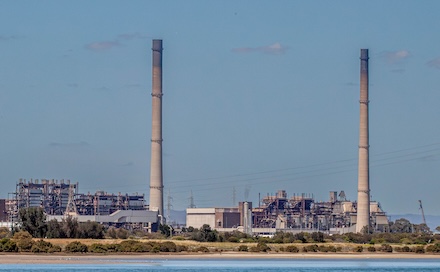
Wathever Taylor and Putin say, it’s on the way out (Torrens Island).
The government’s response has been a dignified silence, and perhaps that’s the best way to treat rude and uncouth louts. But its capacity to respond is limited by its own hypocrisy in its encouragement of fossil fuel exports, a point legitimately expressed by the Greens and some independent MPs. As Ross Gittins writes, Albo has a bob each way on climate change, and for that Labor is bearing a political cost.
Because the government is facing criticism from two opposing sides, the media response is simply to say that Bowen has failed – a strange conclusion because criticism from two opposing sides often suggests a political sweet spot has been reached.
You can hear SBS political correspondent Anna Henderson talking about Bowen’s “failure” in her regular Monday night session on Late Night Live. David Marr points out that COP 31, with its requirement for unanimity, was bound to fail, but Henderson explains that the media’s response is simply to assert that Bowen has failed. It’s a simpler message than a full explanation, and it makes for catchy headlines.
This lazy approach to complex issues is dangerous. It’s far more dangerous than the explicit and easily-recognized bias in the Murdoch media, because it infects respected and trusted media, including our public broadcasters. The message the public gets is about Bowen’s failure, rather than an understanding of the power of the fossil fuel lobby and its influence on Australian politics.
The power of that fossil fuel lobby is described in a Conversation contribution by Christian Downie and William Kakenmaster of ANU, written while the COP negotiations were still underway: Fossil fuel lobbyists are trying to derail climate action once again at COP31. Can they be stopped?. No, they couldn’t be stopped, they explain, because since the last COP they have become so well organized and determined to ensure there is no mention of the phase-out of fossil fuel. They also wanted to block any mention of electrification, but Bowen and his Turkish colleague managed to get agreement on that before the Russians and Saudis wrecked the joint.
There was a certain logic in making the communique a statement on electrification, on the basis that the need to phase out fossil fuels was already established at COP 28 in 2023, but there is also a strong logic in the Europeans’ view that it is almost meaningless to develop policies to combat global warming while assiduously refraining from any mention of the cause of that warming.
There is more to the COP story than the destructive work of the fossil fuel lobby, or the Europeans’ demand for a statement on fossil fuels. Two Conversation contributions – How did the COP31 climate agreement fall apart – and what happens now? by Jacqueline Peel and Kathryn Brown of the University of Melbourne, and What it was like to watch crucial COP climate talks fall apart at the last minute by Mike Perkins, the environment and energy editor of The Conversation, explain in detail what happened at the conference. Delegates at the conference work on many more cooperative matters than the final communique (which is why Taylor’s grizzle about the cost is so petty). And as Peel and Brown explain, COP isn’t the only mechanism of world cooperation on climate change.
But by the same token, COP is not the only forum that the fossil fuel lobby will try to undermine. Tim Nash, of the University of Wellington, was at COP in his role as Chair of the World Climate Research Program. Writing in The Conversation about the COP collapse he reports that the same countries that derailed COP are pushing for a delay of the IPCC next major progress report.
Bowen should be congratulated for doing the best anyone could have done in handling process set up to fail. Although he would be disappointed about the outcome, the whole process has two important messages. One, for the world to understand, is about the power of the fossil fuel lobby, and the pivotal place Putin plays in that lobby. The other, for Australians to grasp, is the unsuitability of Taylor, Tehan, Canavan, Joyce, Hanson and their close colleagues for responsible office in a democracy, demonstrated by their loutish behaviour in and out of Parliament, and their willingness to align themselves with Putin and the fossil fuel lobby.
That message will get through if journalists report dispassionately and don’t just go with the media vibe of the day.
Anti-renewable hysteria in rural Victoria
In rural seats that Labor, Liberal and the Nationals have hitherto taken for granted there will be strong contests in which a passionate and irrational opposition to renewable energy will play a part.
True to form, William Bowe’s Poll Bludger has developed a seat-by-seat guide to the Victorian election with maps and candidates’ margins at the last state election.
At present Labor holds 54 seats in the 88-member Legislative Assembly. The Liberals hold 20 seats, the Nationals 9, the Greens 2, and independents 2, and 1 seat is empty because of a recent death. For the Coalition to win government it would have to pick up 16 seats, which would mean taking all seats which Labor holds with a margin of less than 7 percent. On those figures a Coalition victory over a three-term tired government looks like a foregone conclusion, particularly when the opinion polls are showing a very large swing against Labor.
But messing such simple calculations is a resurgence of One Nation, which, based on its performance in the South Australian election, is likely to do well in non-metropolitan Victoria, where Labor has a string of seats northwest of Melbourne, the Nationals have all their 9 seats, and the Liberals have 5. In those seats, some of which parties have taken for granted in previous elections, there will be some interesting contests according to the ABC’s Warwick Long in his post Regional Victoria feels forgotten by Labor, frustrated at the Coalition and tempted by One Nation. (“Regional” is a term in journalism to refer to anything outside the capital cities.)
Renewable energy is an issue in non-metropolitan Victoria. One might reasonably believe that farmers, being on the front line of the damaging effects of climate change, and subject to high power bills, would be on the front line of support for Australia’s energy transition, and indeed many are. But because of insensitive behaviour by some renewable energy companies, and a strong campaign of lies and disinformation by National, Liberal and One Nation politicians, there is a hysterically strong anti-renewable opposition by some farmers.
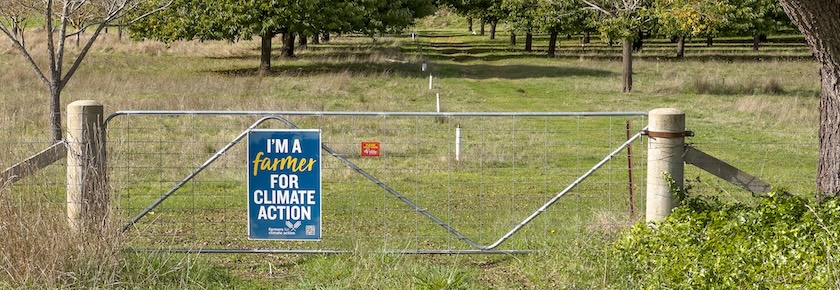
Most farmers see through the fossil fuel lobby scare campaign
Illustrating the point, the ABC’s 730 covers the voting intention of a farmer in the Labor-held Ripon electorate, west of Ballarat. He voted for Liberal in the last election, but he intends to vote One Nation in this election, because he trusts One Nation to be firmer in its stance against renewable energy than the Liberals. His specific issue is the government’s plan to build a high voltage power line on his property. That’s the Victoria-New South Wales Interconnector (“VNI”) designed to bring power from New South Wales to Victoria, without which Victorians won’t be able to enjoy the benefits of low-cost energy from renewable sources, and which will be vital when the state’s aged coal-fired Yallourn Valley station closes in 2028.
The ABC reports that he is running 7000 sheep on 2200 hectares. That’s a high stocking rate, which would surely have involved considerable damage to the natural environment. That’s his right, but it’s extraordinary that he should then be complaining about the aesthetics of a transmission line. What has led him to such inconsistent thinking?
One must wonder what interests lie behind this campaign against renewable energy. In promising to scrap the VNI the Liberals must have judged that some group has stirred up enough opposition to renewable energy to make it worth their while to oppose a project that would deliver power at lower cost and greater reliability to Victorian consumers and businesses.
We should think carefully about who would benefit from stymying our energy transition, and be prepared to look well beyond our shores for the protagonist.